
In 2026, H-1B compliance, including LCA posting and Public Access File management, is under more scrutiny than ever before. With the Trump Administration's renewed focus on enforcement and oversight—especially through the U.S. Department of Labor’s new initiative, Project Firewall—employers and immigration attorneys must take a fresh look at even the most basic compliance questions.
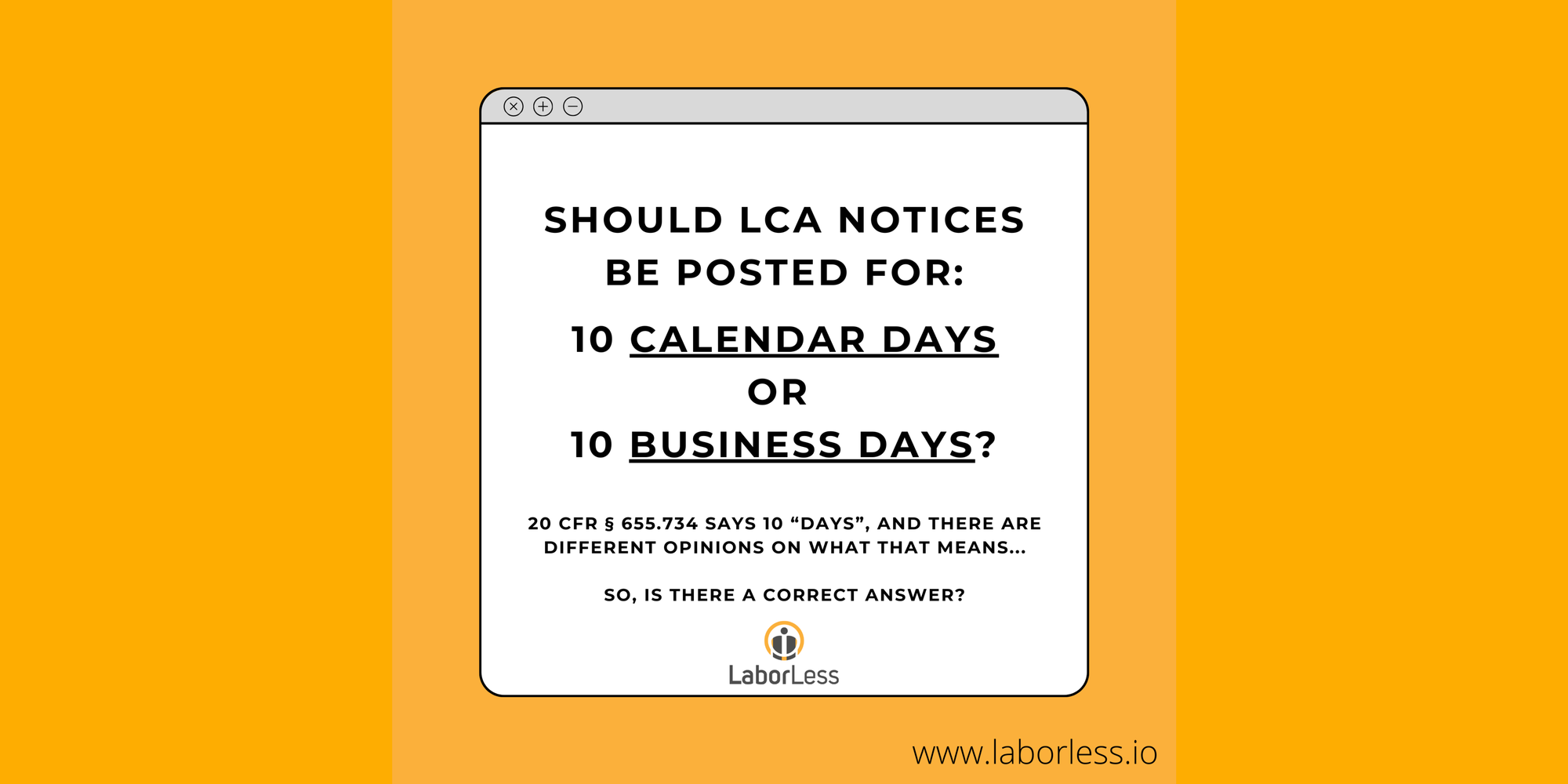
One of those often-overlooked questions: Should LCA posting notices be posted for 10 calendar days or 10 business days? This detail may seem minor, but it can have serious implications during audits or investigations, especially in a climate of heightened enforcement.
Let’s explore what the regulations actually say, how the government has discussed this issue over time, and why now is the time to revisit your approach to LCA compliance—especially if you’re still relying on manual processes.
What the Regulations Say: 20 CFR § 655.734
The foundational regulation for H-1B Labor Condition Application (LCA) posting is 20 CFR § 655.734. This section outlines how and where LCA notices must be posted, and it applies to both hard-copy and electronic postings.
According to the regulation, employers must post the LCA notice:
At two conspicuous locations at each place of employment for 10 days or, in the case of electronic posting, using any “electronic means normally used to communicate with workers,” for the same duration.
However, the rule refers only to “10 days”—not specifically 10 business days, and not 10 calendar days. This ambiguity has sparked a long-running debate in the immigration compliance world.
So, how have agencies and practitioners interpreted it?
The DOL’s Field Assistance Bulletin on Electronic Posting
In 2019, the Department of Labor’s Wage and Hour Division published Field Assistance Bulletin No. 2019-3, one of the most detailed explanations to date on electronic LCA posting compliance.
This bulletin outlines what constitutes a valid electronic posting, including:
- Using intranet systems or digital bulletin boards to notify affected workers, and
- Ensuring the notice is accessible for the required 10 days.
Importantly, the bulletin once again uses only the phrase “10 days”, without clarifying whether that means calendar or business days. So while the FAB brought valuable guidance to the mechanics of electronic posting, it didn’t resolve the calendar vs. business day debate.
COVID-Era Guidance and August 2023 DOL FAQ
During the COVID-19 pandemic, remote work forced many employers to rethink where and how LCAs were posted. The DOL responded with a series of FAQs related to LCA posting and worksite changes in the context of remote work.
But 0n August 24, 2023, the DOL issued a new set of FAQs that explicitly stated they were meant to supersede all previous COVID-related guidance. Most critically, this new guidance referenced that LCA notices must be posted for 10 "calendar" days.
Although this language appeared somewhat casually (rather than in the context of a regulatory change) it was a significant moment for those of us who have followed this issue closely.
As the CEO of LaborLess and a former immigration attorney focused on H-1B visas, I saw this as the DOL’s first clear written statement that “10 days” means 10 calendar days in the context of LCA posting compliance. Of course it was not framed as an official clarification, so it may not necessarily be taken as "law", but for the sake of argument, one might say that it helped clarify the ambiguity that has surrounded LCA posting duration.
PERM: Where the “10 Business Days” Standard Might Come From
Part of the reason many immigration lawyers think that LCA posting notices must be up for 10 "business" days may stem from the PERM Notice of Filing (NOF) requirement, which is regulated under 20 CFR § 656.10. But that regulation clearly states that the PERM NOF must be posted for 10 consecutive business days.
In fact, the DOL’s own PERM FAQ guidance goes further, specifying that weekends and holidays do not count toward the 10-day minimum posting.
It’s likely that some immigration professionals, familiar with the PERM process, applied that same “10 business days” standard to H-1B LCA postings, specifically since the H-1B regulations never clarified otherwise.
But since H-1B LCA posting rules are distinct from PERM, and the DOL now appears to support a calendar-day interpretation in practice, it's a new consideration to keep in mind.
The difference between 10 calendar days and 10 business days may seem small—but in an audit, it could determine whether a company is found compliant or penalized for a technical violation.
It also raises a larger question: How confident are you in your LCA posting and PAF creation process?
Time to Rethink How LCA Compliance Happens
Even if you’ve interpreted the 10-day rule correctly, how you manage the overall process matters just as much.
Many companies and immigration law firms still:
- Email PDFs of LCA notices to clients and hope they get posted
- Ask remote employees to print and tape postings to their home office walls
- Store Public Access Files in binders, shared drives, or not at al
- Rely on emails for audit documentation and version control
This is not sustainable in an era of proactive compliance enforcement.
If there’s no centralized system to create, track, and validate the compliance lifecycle, especially with respect to LCA posting timelines and PAF completeness. employers are exposed to unnecessary risk.
How LaborLess Supports Modern H-1B Compliance
That’s why we built LaborLess. Our platform helps immigration law firms and H-1B employers:
- Post LCA notices electronically in a compliant, visible way that meets DOL standards
- Automate Public Access File creation, including all required documentation
- Track posting timelines and expiration dates to ensure timely compliance
- Maintain centralized visibility and audit trails for all stakeholders
- Auto-purge PAFs after their retention period to minimize liability
And later this year, we’ll be releasing a new module to support PERM Notice of Filing compliance—so you can bring the same level of confidence to your PERM cases as you do to H-1Bs.
To learn more or request a demo, visit www.laborless.io or explore more resources and insights on the LaborLess blog.