
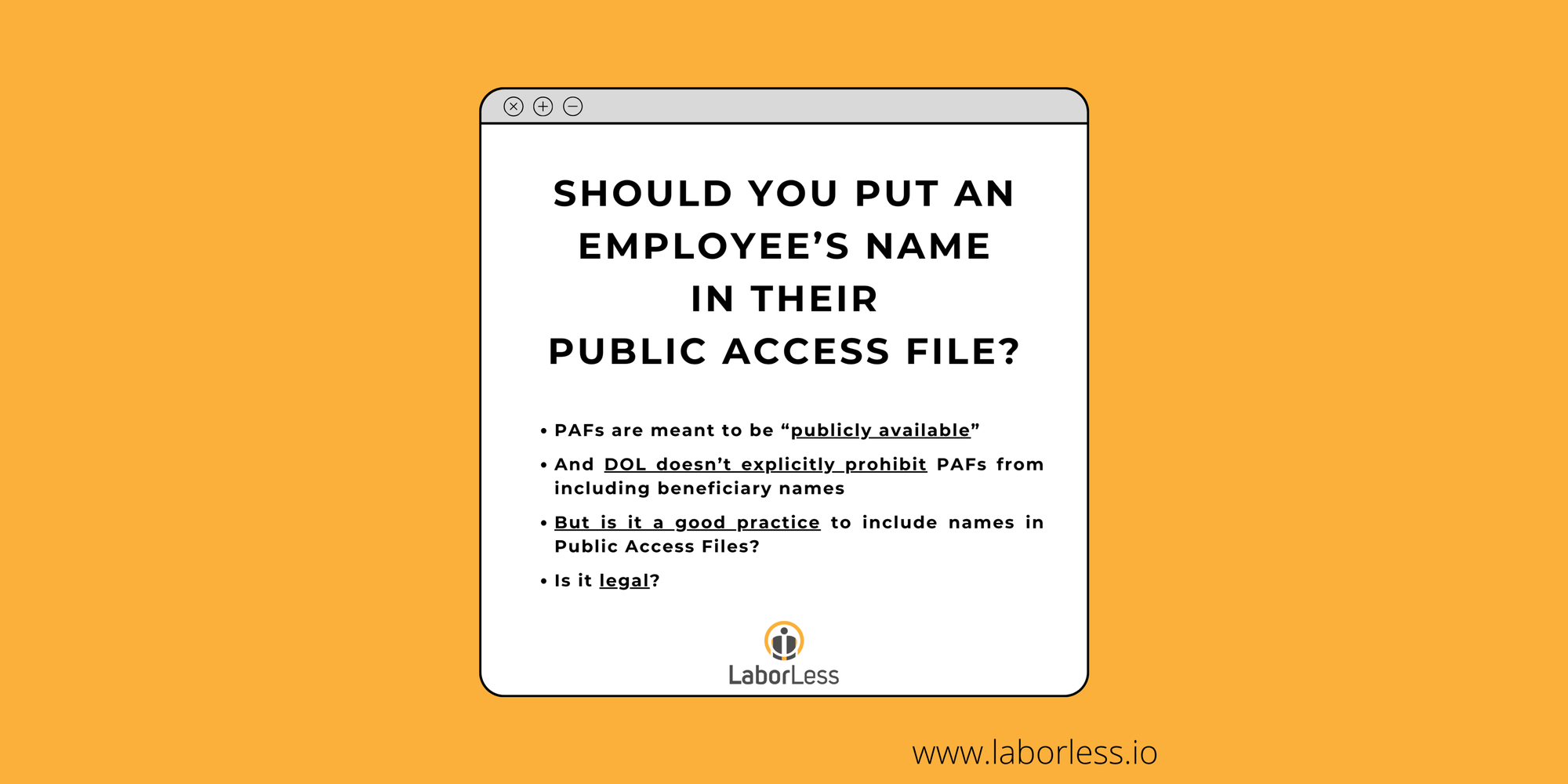
If you handle H-1B cases—whether as an immigration lawyer or part of an in-house global mobility team—you’ve likely spent significant time thinking about Labor Condition Applications (LCAs) and Public Access Files (PAFs). But there’s a more nuanced question that doesn’t come up often enough: should an employee’s name be included in a Public Access File at all?
At first glance, this appears to be a straightforward compliance issue governed by the Department of Labor (DOL). However, when examined more closely, it becomes clear that this question sits at the intersection of regulatory compliance, privacy risk, and modern data management practices.
To answer it properly, we need to separate what the DOL explicitly requires from what may introduce unnecessary legal or operational risk. This distinction is critical, especially in today’s environment of heightened enforcement and growing scrutiny around employee data.
What Does the DOL Actually Require in a Public Access File?
The governing regulation for Public Access Files is 20 CFR § 655.760, which defines the exact documentation employers must maintain and make available. From a compliance perspective, understanding this list precisely is essential, as many organizations either include too little (creating compliance risk) or too much (creating unnecessary exposure).
Required Public Access File Contents (Per 20 CFR § 655.760)
A compliant Public Access File must include the following:
- The certified Labor Condition Application (LCA) (Form ETA 9035 and cover pages)
- Documentation of the wage rate to be paid to the H-1B worker
- A clear explanation of the employer’s actual wage system
- Documentation of the prevailing wage source (such as OES data or a private wage survey)
- A summary of benefits offered to U.S. workers in the same occupational classification
- Proof of LCA notice/posting, including the dates and method of notice
- A corporate structure statement, if multiple entities are involved
- H-1B dependency determination, if applicable
- Recruitment and non-displacement documentation, if the employer is H-1B dependent or a willful violator
What is equally important is what does not appear on this list. The regulation does not require employee names, personal identifiers, or any unnecessary personally identifiable information (PII). From a strict DOL compliance standpoint, including a beneficiary’s name is neither required nor explicitly prohibited. However, that absence is meaningful—it signals that the purpose of the PAF is to demonstrate compliance with wage and labor condition requirements, not to identify specific individuals.
Why the “Public” Nature of Public Access Files Matters
The defining characteristic of a Public Access File is that it must be accessible to the public. The regulation makes this explicit, stating: “The employer shall make a public access file available for public examination… within one working day after the date on which the labor condition application is filed” (20 CFR § 655.760(a)). This requirement fundamentally changes how employers should think about the contents of the file.
Unlike internal HR records, a PAF can be requested by virtually anyone, and the employer must provide access promptly. There is no requirement that the requester be affiliated with the company or have any specific purpose. As a result, anything included in the file should be treated as information that could become broadly accessible. When an employee’s name is included, that public file may effectively disclose more information than the employer would typically intend to share.
Privacy and Legal Risks Beyond DOL Compliance
While the DOL does not prohibit including employee names, other areas of law introduce important considerations. Employers today operate within a patchwork of privacy frameworks that increasingly emphasize limiting the collection and disclosure of personal data to what is necessary.
Key Privacy Considerations for Public Access Files
- State privacy laws: Laws such as the California Consumer Privacy Act and similar statutes in other states require organizations to minimize unnecessary disclosure of personal information and justify how data is used and shared.
- Common law privacy principles: Legal doctrines such as the public disclosure of private facts may create exposure if sensitive information is made broadly available without a legitimate need.
- Data aggregation risks: While individual data may seem harmless, combining an employee’s name with wage information and work location can create a detailed and potentially sensitive profile.
The key issue is not that including a name automatically violates a specific law, but that it introduces risk without providing a clear compliance benefit. In a regulatory environment that increasingly values data minimization, unnecessary inclusion of personal information can become a liability.
The Practical Impact of Including Employee Names
To understand the real-world implications, it helps to consider how information in a Public Access File interacts. A PAF is not a single data point; it is a collection of documents that, when viewed together, provide a detailed snapshot of an employment situation. If that snapshot includes an employee’s name alongside wage data and worksite information—particularly in cases involving remote work—it may reveal more than intended.
This is especially relevant in today’s workplace, where remote and hybrid arrangements are common and where home addresses may appear as worksites on LCAs. In such cases, including a name could inadvertently connect an individual to a residential location and compensation level in a publicly accessible document.
Best Practice: Apply a Data Minimization Approach
Given that employee names are not required, many practitioners are adopting a straightforward guiding principle: include only what is explicitly required by regulation. This approach, often referred to as data minimization, aligns with both compliance requirements and broader privacy expectations.
Why Data Minimization Is Effective
- It ensures full compliance with DOL requirements without adding unnecessary information
- It reduces exposure to privacy-related risks
- It aligns with modern data protection standards
- It simplifies internal compliance processes
Rather than asking whether something is allowed, this approach reframes the question to whether it is required. If the answer is no, it likely does not belong in a Public Access File.
The Bigger Challenge: Lack of Visibility Into PAF Processes
In practice, issues like this often highlight a broader challenge in H-1B compliance. Many organizations rely on manual processes to create and maintain Public Access Files, with responsibilities split between law firms and employer clients. As a result, there is often limited visibility into what is actually included in the file, whether all required documents are present, and whether unnecessary information has been added.
This lack of standardization can lead to inconsistencies across cases and increases the likelihood of both compliance gaps and unnecessary risk exposure. Over time, these small inconsistencies can compound, particularly in organizations handling multiple H-1B cases or working with multiple legal providers.
Modernize Your Public Access File Process with LaborLess
A more modern approach to PAF compliance focuses on centralization and control. By using technology to manage LCA posting and Public Access File creation, organizations can ensure that each file is consistent, complete, and aligned with regulatory requirements. Automated systems can be designed to include only required documentation, exclude unnecessary personal data, and maintain a clear audit trail.
So if you're handling H-1B cases and are not fully confident in how your Public Access Files are being created, maintained, or audited, it may be time to take a closer look at your process. LaborLess enables law firms and employers to post LCA notices electronically, automatically generate compliant Public Access Files, and maintain full visibility into compliance workflows. By centralizing everything in one place, you can ensure that your PAFs are complete, accurate, and aligned with both regulatory requirements and modern data practices.
Visit is at https://www.laborless.io and reach out to learn more!
FAQ: Public Access Files and Employee Names
Do DOL regulations require employee names in a Public Access File?
No. Under 20 CFR § 655.760, employee names are not listed as a required component of a PAF.
Is including an employee’s name a violation?
Not under DOL rules, but it may introduce privacy risks depending on the broader legal context.
Why are Public Access Files public?
They are required to be publicly accessible to ensure transparency and allow verification of compliance with wage and labor condition requirements.
Can a home address appear in a Public Access File?
Yes, if it is listed as a worksite on the LCA, which can raise additional privacy concerns when combined with other information.
What is the safest approach for PAF contents?
Limit the file to what is explicitly required by regulation and avoid including unnecessary personal data.