
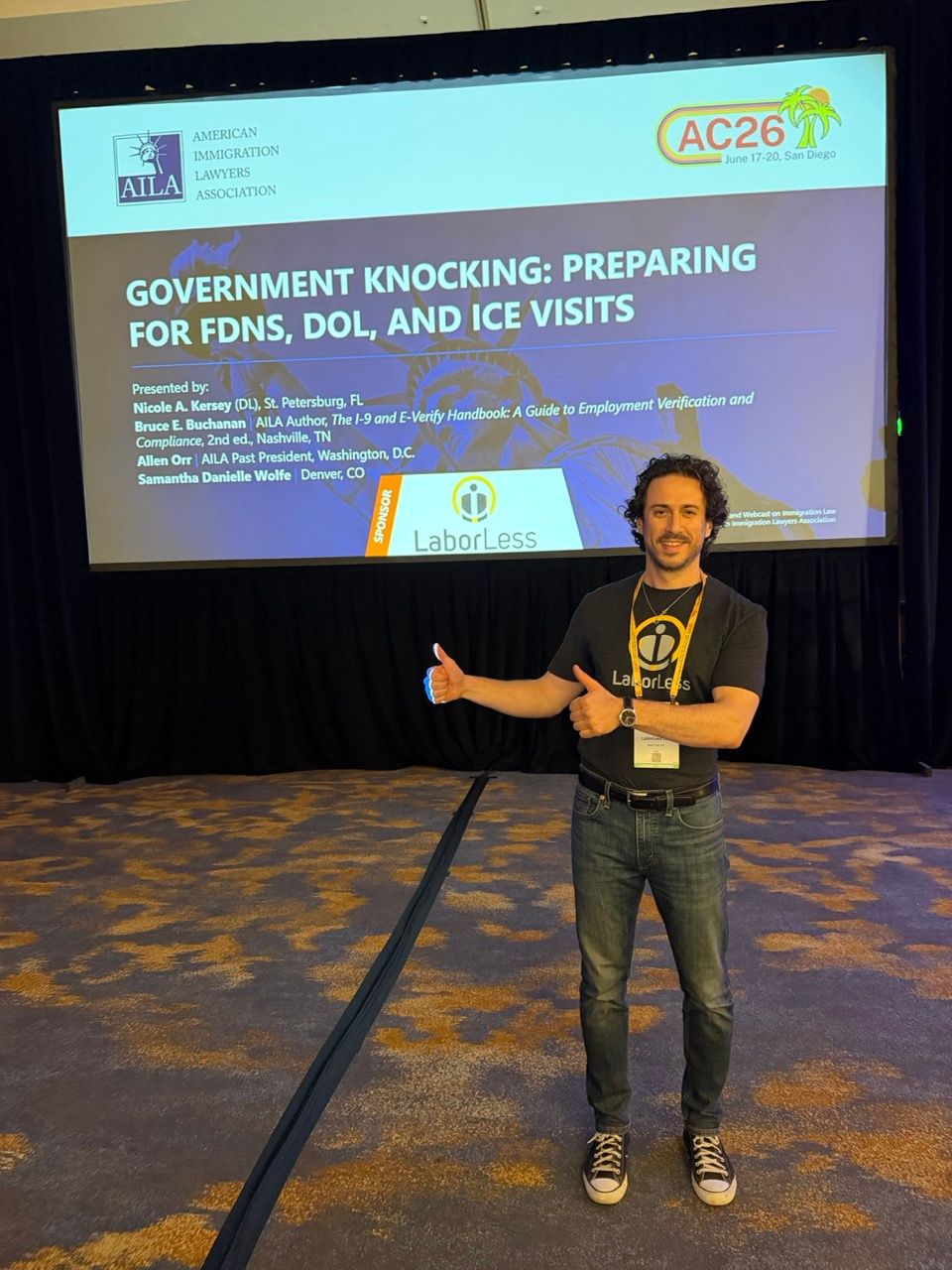
At this year’s American Immigration Lawyers Association Annual Conference, LaborLess had the opportunity to sponsor a session called “Government Knocking: Preparing for FDNS, DOL and ICE Visits.” For anyone handling H-1B compliance, whether as outside immigration counsel or in-house at a sponsoring employer, this was one of the most relevant sessions of the conference.
The reason is simple: H-1B compliance is no longer just about getting the petition approved. It is about being able to prove, sometimes months or years later, that the employer did what it said it would do, that the employee is working where and how the petition described, that wage obligations are being met, and that the Labor Condition Application (LCA) process was handled properly from the beginning.
That has always been true under the law. But in the current enforcement environment, especially with the Department of Labor’s increased focus on H-1B compliance and Project Firewall, the practical risk feels very different. Employers and law firms should be preparing as if someone may eventually ask them to show their work.
FDNS Site Visits Are Likely to Become More Common in H-1B Cases
One of the strongest takeaways from the session was that employers should expect more Fraud Detection and National Security Directorate site visits, including in the H-1B context. USCIS’s Fraud Detection and National Security Directorate conducts site visits to verify information connected to immigration filings, and those visits can involve questions about the petitioning employer, the worksite, the job duties, and whether the beneficiary is doing the work described in the filing. USCIS explains the directorate’s role on its official Fraud Detection and National Security Directorate page.
That means the H-1B employee should not be treated as an afterthought in the petition process. As Allen Orr emphasized during the panel, the beneficiary should know what is in their file. Not just the generic job description, but the real details of the role, worksite, salary, and job duties.
For H-1B employers, that means the employee should understand:
- What job duties were described in the H-1B petition
- What work they actually do and do not perform
- How much they are supposed to be paid
- Where they are authorized to work
- Whether remote or hybrid work was included in the filing strategy
- When to tell HR or immigration counsel about changes
This matters because the employee is often on the front line of their own status. If an FDNS officer shows up or calls, the employee may be asked questions before the lawyer or HR team has time to prepare a response. If the employee’s explanation does not match the petition, that mismatch can become a problem even if the underlying case was approvable.
The best time to address this is before anything goes wrong. H-1B employees should understand that if they move, change worksites, change job duties, receive a salary change, change titles, or start working in a meaningfully different arrangement, they need to tell the company and immigration counsel immediately. Compliance is not just something that happens at filing. It has to be maintained during the entire H-1B employment period.
DOL Audits Are No Longer Just Complaint-Driven
The second major takeaway was the changing nature of Department of Labor enforcement.
Historically, many employers thought of DOL H-1B investigations as mostly complaint-driven. In other words, if no employee complained, they assumed the likelihood of an investigation was low. That was never a perfect assumption, but it is especially dangerous now.
Under the H-1B statute, the Secretary of Labor has authority in certain circumstances to certify an investigation into an employer’s LCA compliance practices. That authority is tied to the broader enforcement framework under 8 U.S.C. § 1182(n), which governs many of the wage, working condition, notice, and enforcement obligations connected to H-1B employment. DOL also maintains an official H-1B program page outlining employer obligations and worker protections.
For employers and immigration law firms, the practical takeaway is clear:
- H-1B audits may arise even without a worker complaint
- LCA compliance practices may be reviewed after filing
- Agency information-sharing can expose inconsistencies
- Wage, worksite, job duty, and posting records need to line up
- Employers should assume their records may eventually be compared across systems
Project Firewall has made this shift more visible. The point is not simply that DOL can investigate. The point is that employers should not assume that a lack of complaints means a lack of risk. Agencies are also sharing information more actively, and an issue in one system can create questions in another. DOL, ICE, the Department of Justice’s Immigrant and Employee Rights Section, EEOC, USCIS, and even tax-related information can overlap in ways that employers may not expect.
For companies, that means consistency matters. The LCA should match the petition. The petition should match the employee’s actual role. The wage records should match the wage obligation. The worksite should match the posting and filing strategy. When those pieces do not line up, the employer may have a difficult story to tell later.
LCA Posting Is Still a Core H-1B Compliance Requirement
One of the most practical issues discussed during the session was LCA posting, especially for remote workers. DOL’s H-1B regulations require employers to provide notice of the Labor Condition Application to affected workers. The specific notice rules are found at 20 CFR § 655.734, which explains when and how notice must be provided, including hard-copy and electronic notice options.
For traditional office environments, LCA posting was already operationally annoying. For remote and hybrid work, it becomes much more complicated. If the home is the worksite, the employer still has to think carefully about how notice is being provided to affected workers.
A few practical LCA posting questions employers should be asking:
- Was the LCA notice posted before the H-1B petition was filed?
- Was the notice posted for the required time period?
- Was the posting made at the correct worksite?
- If the employee works remotely, was the home worksite addressed?
- Was electronic posting used in a way that affected workers could actually access?
- Was proof of posting captured and saved in the Public Access File (PAF)?
During the session, Samantha Wolfe addressed a point that comes up often: DOL has previously made comments suggesting it does not “expect” employees to post LCAs on their refrigerators at home. But that type of comment is not the same as black-letter law. The regulation still requires notice connected to the place of employment, and employers should be cautious about relying on informal comments as a compliance strategy.
This is one of the strongest practical arguments for electronic LCA posting. DOL has recognized electronic notice as an option when it is provided in a way that is readily available to affected workers, and its Field Assistance Bulletin on electronic notice provides helpful guidance on this topic. Employers and law firms should review DOL Field Assistance Bulletin 2019-3, which discusses electronic posting in the H-1B context.
The takeaway is not that every remote work scenario is identical. The takeaway is that remote worksite posting cannot be ignored. Employers need a process that is repeatable, documented, and auditable.
Public Access Files Matter More Than Ever
The panel also reinforced something LaborLess has been focused on for years: the Public Access File is not an afterthought.
Under 20 CFR § 655.760, employers must make a Public Access File available within one working day after the LCA is filed. The PAF is the employer’s core evidence file showing that the LCA process was handled properly.
A strong H-1B Public Access File should generally include:
- A copy of the certified Labor Condition Application
- The wage rate paid to the H-1B worker
- A summary of the actual wage system
- The prevailing wage source and methodology
- A summary of benefits offered to U.S. workers and H-1B workers
- Documentation showing that LCA notice was provided
- Additional H-1B dependency or corporate documentation where required
This is where many employers struggle. The LCA may be filed correctly, but the proof of compliance may be scattered across emails, PDFs, folders, HR systems, payroll records, or old case management notes. That may work until someone asks for the file quickly. At that point, “I think it is somewhere” is not a compliance strategy.
For law firms, this creates a real question: if you are advising on the LCA and H-1B filing process, should you also be helping the employer manage the PAF process? The panelists suggested that law firms should strongly consider owning or managing more of that process because it is directly tied to the employer’s compliance story.
At minimum, the employer and law firm should know who is responsible for creating the PAF, when it is created, what goes into it, where it is stored, how posting proof is captured, and how the file will be produced if requested.
Wage and Hour Issues Can Become Expensive Quickly
Another important takeaway was that DOL Wage and Hour investigations can become very granular. The issue is not always whether the W-2 looks correct at the end of the year. In some cases, investigators may look at whether the required wage was paid properly during each relevant pay period.
That distinction matters. An employer may think it has satisfied the wage requirement because the annual compensation appears to meet the required wage, but if the employee was underpaid during certain pay periods, that can still create exposure. DOL’s Fact Sheet #62H explains that H-1B employers must pay the required wage and comply with the labor condition statements made in the LCA.
This can be especially risky in industries or roles where employers are used to paying by visit, by piece, by shift, or through other compensation structures that do not neatly align with H-1B wage obligations. Once Wage and Hour gets involved, the review can expand into back wages, interest, and payment plans. For employers operating on thin margins, that can be painful.
What H-1B Employers and Law Firms Should Do Now
The broader message from the session was clear: employers need to tighten their compliance documentation, and law firms need to make sure the process actually happens.
A modern H-1B compliance process should be:
- Transparent, so the employer and law firm can see what has been done
- Centralized, so records are not scattered across inboxes and folders
- Auditable, so evidence can be produced quickly if requested
- Consistent, so LCA, petition, payroll, and worksite records align
- Scalable, so remote work, hybrid work, and multiple worksites do not create chaos
That means H-1B compliance cannot live only in attorney inboxes, HR spreadsheets, or one-off emails asking someone to post something somewhere. It needs to be structured. It needs to be visible. It needs to create evidence as the process happens, not after the fact when everyone is trying to reconstruct what occurred.
For H-1B employers, this means reviewing LCA posting procedures, remote worksite posting practices, Public Access File workflows, wage records, and internal change-notification processes. For immigration law firms, it means helping clients understand that LCA compliance is not just a filing step. It is part of the ongoing risk management surrounding every H-1B case.
Final Thoughts: H-1B Compliance Needs to Be Proactive, Not Reactive
The key lesson from “Government Knocking: Preparing for FDNS, DOL and ICE Visits” is that employers should not wait until the government knocks to figure out whether their files are organized, their postings were done correctly, or their wage records match their obligations.
By then, it may already be too late.
If you handle H-1B compliance for clients, or you work in-house at a company that sponsors H-1B workers, and you do not have a streamlined, transparent, and auditable LCA compliance process, now is the time to fix that.
At LaborLess, we have spent a decade building a platform to help employers and immigration law firms manage electronic LCA posting, Public Access Files, and now PERM Notice of Filing compliance in a more organized, auditable way.
To learn more, visit www.laborless.io or reach out directly.