
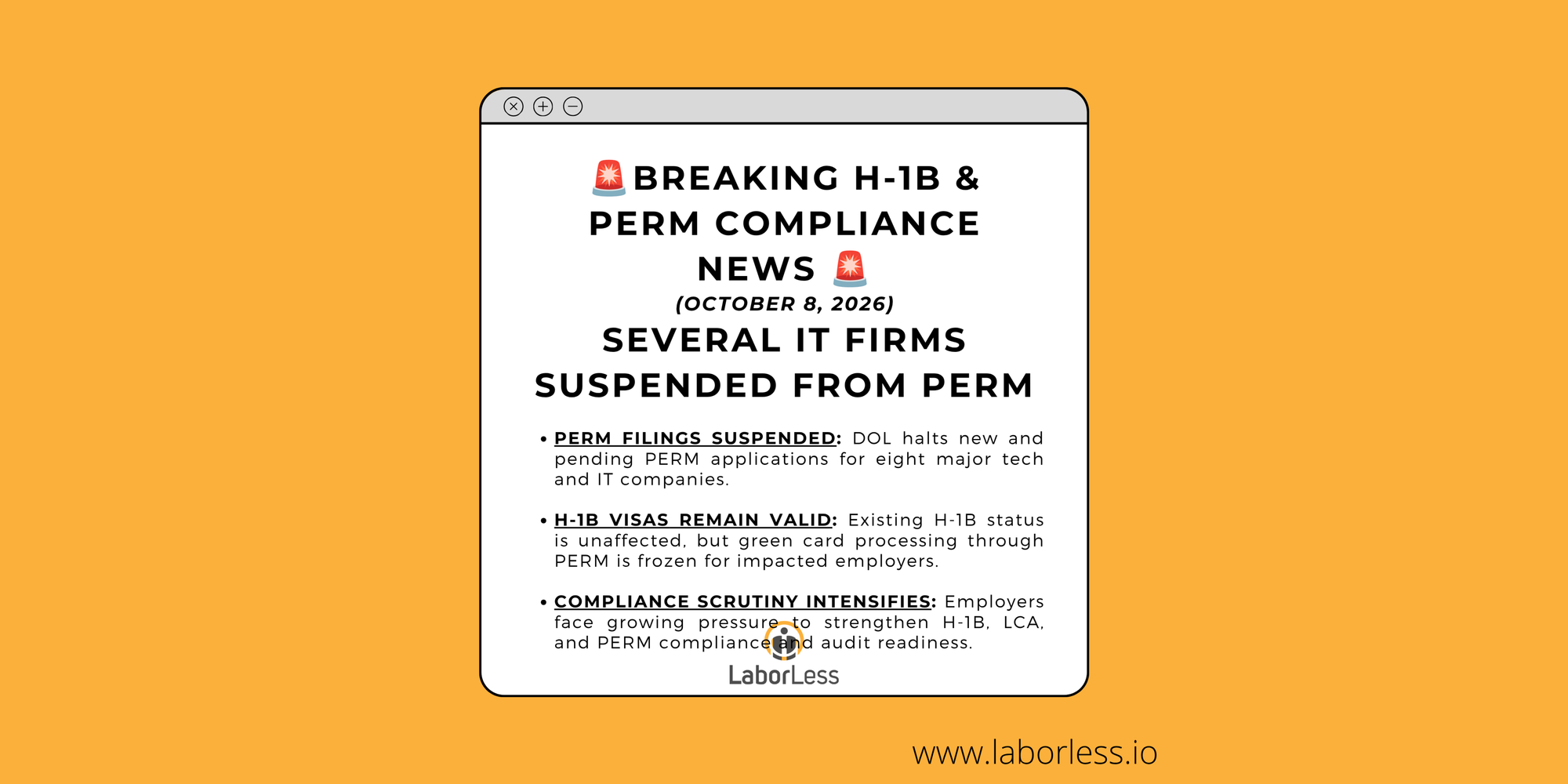
On October 8, 2026, U.S. Secretary of Labor Keith Sonderling and Vice President JD Vance announced that the Department of Labor (DOL) announced the suspension of participation in the Permanent Labor Certification (PERM) program for eight major technology and IT services companies, including Microsoft, Adobe, Cognizant, Infosys, Tata Consultancy Services, Wipro, HCL, and Capgemini.
The announcement represents another significant development in the federal government's increasingly aggressive approach to employment-based immigration enforcement. It also raises immediate questions for employers sponsoring foreign national employees, immigration law firms managing corporate immigration programs, and H-1B workers whose long-term plans depend on employment-based permanent residency.
According to the announcement, the Department will stop accepting new PERM applications and processing pending applications involving the affected companies. The administration cited alleged program abuse and concerns about the displacement of American workers, with Microsoft and Adobe specifically identified in connection with ongoing federal investigations. These are government allegations, not findings of wrongdoing established against every company named.
This announcement reinforces a trend that employers and immigration attorneys have been watching for more than a year: H-1B compliance, Labor Condition Application (LCA) compliance, Public Access File (PAF) management, and PERM compliance are becoming increasingly important parts of corporate immigration risk management.
For companies that have historically treated immigration compliance as a series of administrative tasks, this is another reason to reconsider how those processes are managed, documented, and audited.
What Did the Department of Labor Announce on October 8, 2026?
Eight Major Technology and IT Services Companies Face PERM Suspensions
During the October 8 announcement, Secretary Sonderling identified six major global IT outsourcing and consulting companies whose participation in the PERM program would be suspended:
- Cognizant
- Infosys
- Tata Consultancy Services (TCS)
- Wipro
- HCL
- Capgemini
He also identified two U.S. technology companies, Microsoft and Adobe, citing multiple ongoing federal investigations.
The Department's announced action applies to new and pending permanent labor certification applications involving these employers. In other words, the affected companies cannot proceed through ordinary DOL PERM processing while the announced suspension remains in effect.
The announcement did not establish a definitive end date or publicly explain every procedural detail governing existing cases. Employers and employees affected by the suspension will therefore need to follow subsequent DOL guidance, formal notices, and any legal developments carefully.
What Vice President JD Vance Said About American Workers and Immigration Programs
Vice President Vance framed the decision around the administration's stated objective of protecting employment opportunities for American workers.
He singled out Microsoft, arguing that the company had pursued foreign-worker sponsorship while laying off U.S. employees. The administration presented this as evidence of problems in how employment-based immigration programs have been used.
These statements are significant because the government's concerns are not limited to whether a particular immigration form was completed correctly. They reflect a broader examination of the relationship between foreign-worker sponsorship, domestic recruitment, wages, layoffs, and employer hiring practices.
During the same announcement, officials also discussed investigations involving universities and the J-1 exchange visitor program. The Department's inspector general indicated that subpoenas had been issued in connection with those investigations.
The combination of PERM suspensions and university investigations suggests that the administration is looking across multiple employment-related immigration programs rather than focusing exclusively on H-1B petitions.
That distinction matters for immigration compliance teams. An employer's immigration program may involve H-1B sponsorship, PERM labor certification, employee worksite changes, wage determinations, recruitment, and public-access documentation. Although each process has its own legal requirements, they can become interconnected during a broader government review.
What Does the PERM Suspension Mean for Employers and Foreign National Employees?
PERM Is a Critical Step in Many Employment-Based Green Card Cases
The PERM labor certification process is administered by the DOL and is generally required before an employer can file an immigrant petition in many EB-2 and EB-3 employment-based green card cases.
The process is designed to test the U.S. labor market and establish that the employer has satisfied applicable recruitment and labor certification requirements for the sponsored position.
For many foreign national professionals, particularly H-1B workers, PERM is an important step toward permanent residence. It is also a process that requires careful planning because recruitment, prevailing wage determinations, filing timelines, and subsequent immigrant petition stages can take considerable time.
A suspension of PERM processing therefore affects more than an employer's ability to initiate new green card cases. It can also disrupt long-term immigration planning for employees whose cases are already underway.
Existing H-1B Status Is Not Automatically Revoked
The announcement does not, by itself, revoke existing H-1B approvals or terminate the H-1B program for the affected employers.
H-1B classification and PERM labor certification are separate legal processes. However, the inability to advance a PERM case may potentially have serious downstream consequences for employees approaching their H-1B time limits, particularly where continued eligibility depends on the timing or progress of employment-based permanent residence proceedings.
Affected employees should review their circumstances with immigration counsel.
The same distinction applies to employers. A PERM suspension does not necessarily eliminate continuing H-1B obligations, including LCA wage, notice, and recordkeeping requirements.
Why the PERM Suspension Matters Beyond the Eight Named Employers
Project Firewall Already Signaled a More Aggressive H-1B Enforcement Strategy
On September 19, 2025, the DOL announced Project Firewall, an initiative designed to strengthen enforcement of H-1B employer obligations and protect U.S. workers.
Under Project Firewall, the Department emphasized the use of Secretary-certified investigations, increased information sharing among federal agencies, and closer coordination with the Department of Justice, Equal Employment Opportunity Commission, and U.S. Citizenship and Immigration Services.
The DOL also identified potential enforcement consequences, including back wages, civil monetary penalties, and debarment from future participation in immigration programs.
Project Firewall was particularly noteworthy because it emphasized proactive enforcement. Employers could no longer assume that an investigation would necessarily begin with a worker complaint or an obvious filing irregularity.
The Department's approach also indicated that immigration compliance would be evaluated alongside broader employment practices, including wage protections, displacement concerns, and potentially discriminatory recruitment.
The October 2026 PERM suspensions fit within that broader enforcement direction. They involve a different immigration program and different legal requirements, but they demonstrate the administration's willingness to take significant action against major employers when it believes foreign labor programs are being misused.
For immigration law firms and corporate immigration teams, the practical implication is that compliance should be treated as an ongoing operational responsibility, not simply something reviewed when an H-1B petition or PERM application is filed.
H-1B and PERM Compliance Are Different, but Both Depend on Reliable Records
One important distinction is that PERM compliance and H-1B LCA compliance are not interchangeable.
PERM labor certification generally focuses on the labor market test, recruitment, wage requirements, and other conditions governing an employer's sponsorship of a foreign worker for permanent employment.
H-1B compliance involves a separate set of employer attestations and ongoing obligations, including wages, working conditions, required notice to affected workers, and maintenance of a Public Access File.
However, both programs depend on employers being able to demonstrate that they followed the applicable rules at the appropriate time.
This is where documentation becomes especially important. A company may have completed a required posting or recruitment step, but if it cannot establish when the activity occurred, what information was made available, and whether the applicable requirements were satisfied, it can face avoidable questions during an audit or investigation.
Reliable compliance records do not guarantee that a company will avoid government scrutiny. They do, however, help the employer and its counsel respond with a clear account of what was done and when.
H-1B LCA Compliance: Why Electronic Posting and Public Access Files Matter
Understanding the H-1B LCA Posting Requirement
Before an employer can sponsor an H-1B worker, it generally must obtain a certified Labor Condition Application from the DOL.
Under 20 CFR § 655.734, employers must provide notice of the LCA filing to affected workers through an authorized method, which may include physical posting or electronic notification.
The notice must be provided within the regulatory timeframe and, for posting methods, maintained for the required period of at least 10 days.
The DOL's Field Assistance Bulletin 2019-3 provides additional guidance on electronic LCA posting. Importantly, electronic notice must actually reach the intended audience through a method that makes the information available to affected workers.
This becomes more complicated when employees work across corporate offices, client sites, and remote locations.
An employer may have a well-established process for posting notices at its headquarters, but that does not necessarily establish compliance for employees working elsewhere.
The DOL has specifically recognized that affected workers may include employees of third-party companies working at the same location. Consequently, H-1B employers need to consider whether their notice procedures appropriately address third-party worksites.
The Compliance Risks of Manual LCA Posting
Many employers and immigration law firms still rely on email-based posting processes.
An immigration attorney sends the LCA posting notice to an HR contact, instructs that person to post it at the appropriate location, and requests confirmation once the posting is complete.
For remote employees, the process may involve asking someone to print a notice and post it at home. For third-party worksites, it may require coordinating with a client organization that has its own HR procedures and internal systems.
These arrangements can work when properly implemented. However, they create several recurring compliance challenges:
- Posting visibility: Was the notice actually accessible to the affected workers who needed to see it?
- Posting duration: Was the notice maintained for the required period, and can the employer demonstrate the start and end dates?
- Third-party worksites: Was the posting completed at the correct client location, rather than merely sent to a contact there?
- Remote work: Did the electronic or physical notice method appropriately account for employees working outside a traditional office?
- Posting evidence: Can the employer produce reliable documentation showing what was posted, where it was posted, and when it was removed?
The difficulty is not necessarily that HR personnel or attorneys are failing to perform their responsibilities. Rather, the process often depends on several people, multiple email threads, and separate systems that do not provide a centralized record.
An email confirming that someone was instructed to post a notice is not necessarily the same as evidence that the posting requirement was satisfied.
As government scrutiny increases, employers and law firms should consider whether their existing procedures provide sufficient visibility into the actual completion of compliance activities.
Public Access File Compliance Is Equally Important
H-1B employers must also maintain a Public Access File containing documentation required under 20 CFR § 655.760.
Required PAF documentation includes, as applicable, the certified LCA, wage-related documentation, an explanation of the employer's actual wage system, prevailing wage information, benefits documentation, and evidence of compliance with notice requirements.
The required public-access materials must generally be available within one working day after the LCA is filed.
A complete PAF is more than a folder containing a certified LCA. It is a collection of records that should demonstrate compliance with several separate employer obligations.
Common problems include missing wage memoranda, incomplete benefits statements, absent posting evidence, inconsistent documentation, and files that cannot be located promptly when requested.
Retention also matters. Under the applicable rules, required PAF records must be maintained for the appropriate period, with different retention rules potentially applying to payroll and other supporting records.
Keeping a PAF longer than required is not itself a violation. However, unnecessary retention can increase the volume of records an employer must manage and potentially produce during a review. Conversely, premature destruction can create a direct recordkeeping problem.
A reliable PAF management process should therefore address both completeness and lifecycle management.
PERM Notice of Filing Compliance: Another Area Employers Should Reevaluate
PERM Notice of Filing Requirements Under 20 CFR § 656.10
Although the October 2026 announcement concerns PERM labor certification, the suspension itself is not a finding that the affected employers violated Notice of Filing requirements.
Nevertheless, the announcement is a useful reminder that PERM compliance includes several important procedural obligations, including the Notice of Filing, commonly referred to as the PERM NOF.
Under 20 CFR § 656.10, employers generally must provide notice of the filing of an application for permanent labor certification to the appropriate bargaining representative or, where there is no such representative, through the required workplace posting procedures.
For the applicable workplace posting requirement, the notice must be posted for at least 10 consecutive business days, within the prescribed period before filing the PERM application.
Employers must also comply with applicable in-house media requirements, including electronic or printed communications used in the normal course of recruiting for similar positions.
The regulation expressly distinguishes PERM's 10-business-day posting requirement from the H-1B LCA regulation's 10-day language. Employers should not automatically assume the same timing rules apply to both programs.
Why PERM NOF Documentation Deserves More Attention
PERM Notices of Filing can appear administratively straightforward. Once the notice has been prepared, someone posts it, records the dates, and retains the documentation.
But as with LCA posting, the actual process can involve multiple departments and locations.
An immigration law firm may prepare the notice and send it to the employer. The employer may then be responsible for coordinating the posting, ensuring the notice remains visible, confirming the correct duration, and returning evidence to counsel.
Where the employer has numerous offices or multiple PERM cases underway, these activities can become difficult to track consistently.
A stronger PERM NOF compliance process should establish a reliable record of the notice, the posting location, the posting period, and the documentation supporting completion of the requirement.
Technology can assist with electronic components of this process, automated tracking, and evidence retention. It does not eliminate any physical workplace posting obligation that remains applicable under the PERM regulations.
That distinction is especially important for employers considering electronic PERM NOF tools. A compliant workflow must account for the complete regulatory requirement, rather than assuming that publishing a notice online is sufficient in every circumstance.
How LaborLess Helps Immigration Law Firms and Employers Strengthen H-1B and PERM Compliance
The enforcement developments of 2025 and 2026 reinforce why LaborLess continues to invest in H-1B and PERM compliance technology.
Many immigration compliance obligations are repetitive, document-intensive, and time-sensitive. They also frequently involve coordination among outside immigration counsel, internal HR teams, and employees working across multiple locations.
LaborLess helps immigration law firms and corporate employers automate these processes, reduce manual work, and maintain reliable compliance records through several core features:
- Electronic LCA Posting: Manage H-1B LCA postings across corporate offices, remote worksites, and third-party client locations through centralized electronic posting systems, including websites, internal portals, and QR codes.
- Automated Posting and Takedown: Track LCA posting periods, automatically remove notices after the required posting period, and maintain evidence of when notices were posted and removed.
- Automatic Public Access File (PAF) Creation: Generate and organize PAFs as part of the LCA workflow, including certified LCAs, wage documentation, benefits statements, and posting evidence.
- Comprehensive Audit Trails: Maintain records of posting activity, document changes, user actions, and timestamps, making it easier to retrieve documentation during internal reviews or government investigations.
- PAF Retention and Destruction: Manage PAF expiration dates and automate destruction based on configured retention schedules, helping employers maintain organized records without relying on manual reminders.
- PERM Notice of Filing (NOF) Compliance: Manage electronic PERM NOF postings, track posting periods, automate takedowns, and generate supporting audit documentation. Employers remain responsible for satisfying any applicable physical posting and other regulatory requirements.
- Centralized Compliance Management: Give immigration law firms and authorized corporate personnel access to relevant LCA and PAF records, reducing reliance on email chains, manual confirmations, and disconnected document repositories.
These features help employers and immigration law firms reduce administrative risk, improve audit readiness, and establish more consistent H-1B and PERM compliance processes.
Importantly, LaborLess automates administrative compliance workflows and documentation. It does not replace immigration counsel or make legal determinations about whether a particular LCA, PERM filing, or H-1B amendment is required.
So if you're an immigration law firm looking to automate H-1B LCA posting, Public Access File management, or PERM NOF compliance for your corporate clients, or an in-house immigration professional interested in managing these processes directly, visit LaborLess to learn more: https://www.laborless.io.
The regulations may evolve, and enforcement priorities will certainly change. But employers' need for accurate, accessible, and defensible immigration compliance records will remain.
Frequently Asked Questions About the October 2026 PERM Suspension and Immigration Compliance
Which companies were suspended from the PERM program in October 2026?
The DOL announced suspensions involving Cognizant, Infosys, Tata Consultancy Services, Wipro, HCL, Capgemini, Microsoft, and Adobe. The announcement affects the Department's acceptance of new and processing of pending PERM applications involving these companies, subject to further official guidance and developments.
Does the PERM suspension cancel existing H-1B visas?
No. The announced PERM suspension does not automatically cancel existing H-1B visas or approvals. However, it may affect employees' ability to advance employment-based permanent residence cases and could create longer-term immigration planning issues.
What is the difference between H-1B LCA compliance and PERM compliance?
H-1B LCA compliance concerns obligations associated with temporary H-1B employment, including wage attestations, working conditions, notice to affected workers, and Public Access File documentation. PERM compliance concerns labor certification requirements for many employment-based green card cases, including recruitment, prevailing wage requirements, and the Notice of Filing.
How long must an H-1B LCA notice be posted?
The H-1B LCA regulation requires notice for at least 10 days. Employers should review the applicable DOL guidance and consult counsel regarding the appropriate posting-period calculation and method.
How long must a PERM Notice of Filing be posted?
For the applicable workplace posting requirement, the PERM regulations specify at least 10 consecutive business days. The notice must also satisfy the regulatory timing and content requirements, and employers must address any applicable in-house media obligations.
What documents belong in an H-1B Public Access File?
A PAF generally includes the certified LCA, documentation of the employer's wage determination methodology, prevailing wage information, benefits-related documentation, and evidence of compliance with required notice procedures, together with other records required by the regulations as applicable.
Can immigration compliance software replace legal review?
No. Compliance technology can automate posting, recordkeeping, reminders, document management, and audit-trail generation. Legal determinations about H-1B eligibility, LCA coverage, PERM recruitment, required amendments, and other immigration obligations should remain with qualified immigration counsel and responsible employer personnel.