
On November 16, 2026, the U.S. Department of Labor (DOL) released a sweeping proposal to modernize the Permanent Labor Certification Program, commonly known as PERM. The 350-page Notice of Proposed Rulemaking (NPRM), titled Modernizing the Labor Market Test and Improving Protections for U.S. Workers in the PERM Immigrant Visa Program, addresses everything from traditional recruitment methods and worker protections to the documentation employers must maintain when sponsoring foreign workers for permanent residence.
The proposal represents one of the most significant potential changes to PERM compliance in years. DOL wants to move away from certain traditional recruitment practices, expand protections for U.S. workers, and strengthen oversight of employers participating in the labor certification process. The agency also proposes eliminating Schedule A processing, changing recruitment and layoff-related obligations, and requiring employers to provide more supporting documentation when filing PERM applications.
But some of the most consequential changes for immigration law firms and corporate immigration teams concern a comparatively routine part of the process: the PERM Notice of Filing (NOF).
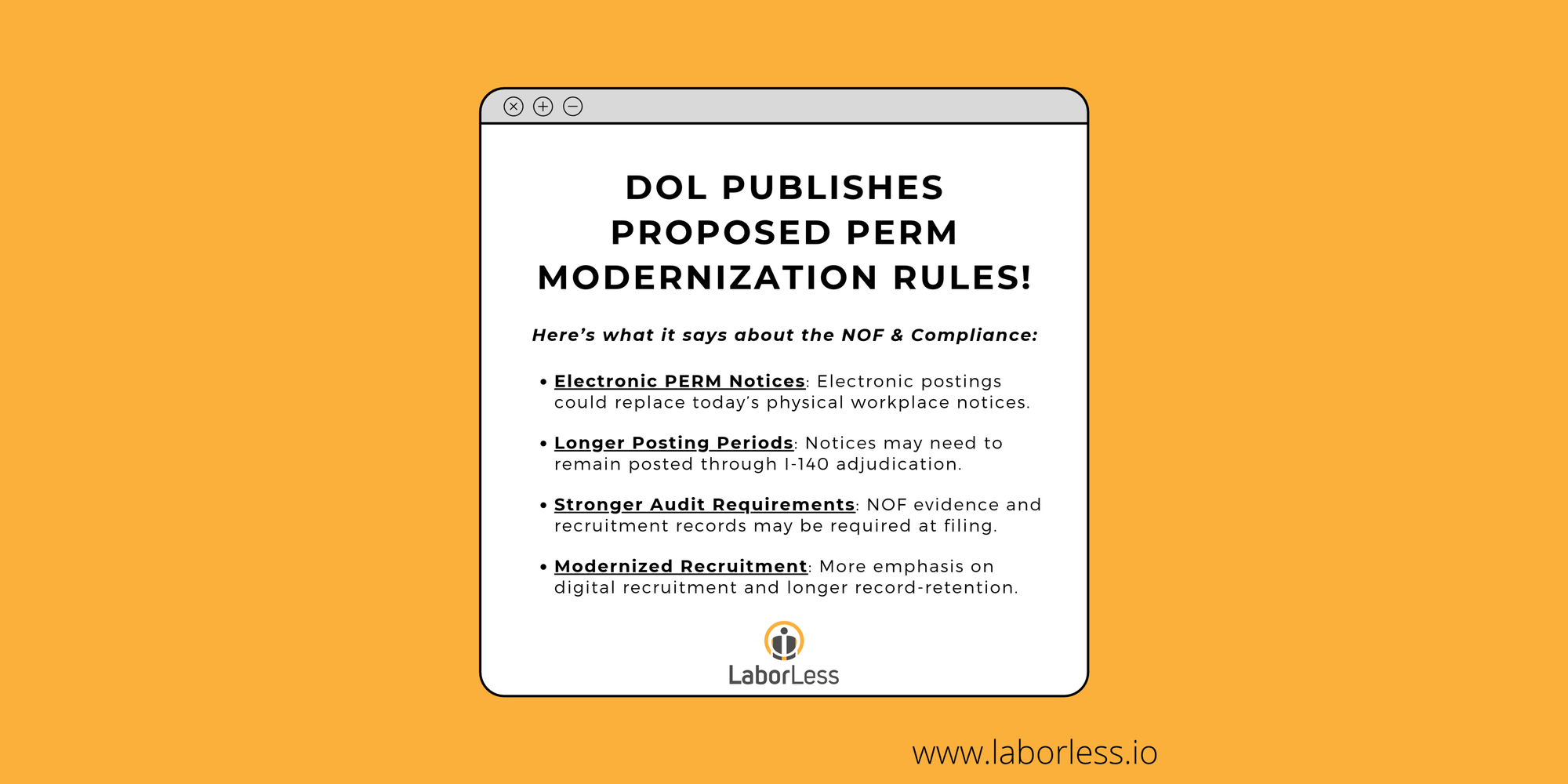
Under the proposed regulations, employers could potentially replace physical NOF postings with qualifying electronic notices. At the same time, those notices could have to remain available much longer, employers would face more explicit documentation requirements, and records that have traditionally been kept for possible audits could become part of the standard PERM filing process.
For companies managing dozens, hundreds, or thousands of PERM applications, these changes could substantially affect how compliance is administered.
This article examines what DOL is proposing, how it compares with current PERM requirements, and what employers and immigration attorneys should consider as the rulemaking process moves forward.
Important: The November 2026 NPRM is a proposed rule, not a final regulation. Existing PERM requirements remain applicable unless and until changes are finalized and take effect.
Why DOL Is Proposing to Modernize PERM Compliance
The PERM labor certification process is intended to help DOL determine whether qualified U.S. workers are available for a particular permanent job opportunity and whether employing a foreign worker would adversely affect similarly employed U.S. workers.
Employers generally must conduct prescribed recruitment activities, consider U.S. applicants, and maintain documentation demonstrating compliance before obtaining labor certification.
However, many of the existing recruitment and Notice of Filing regulations were developed when workplace communication and hiring practices looked substantially different.
Today, employers advertise positions through online job boards, social media, and applicant-tracking systems. Corporate employees may work remotely, travel regularly, or operate across multiple physical locations. HR announcements, employment policies, and internal job opportunities are often distributed electronically rather than on office bulletin boards.
DOL's proposal acknowledges this changing environment while seeking to make PERM recruitment and compliance documentation more transparent.
The result is a proposal that combines two developments that may initially appear contradictory: greater flexibility to use electronic systems, alongside potentially more demanding posting, documentation, and record-retention obligations.
For employers and immigration law firms, understanding both sides of that equation will be essential.
1. Electronic PERM Notice of Filing Could Replace Physical Workplace Posting
What Are the Current PERM Notice of Filing Requirements?
Under the current regulation, 20 CFR § 656.10(d), employers must provide notice of the filing of a PERM application.
Where there is an applicable bargaining representative, notice generally must be provided to that representative. In the standard nonunion case, the employer must physically post the NOF at the facility or location of employment.
The notice must be clearly visible and unobstructed, displayed where U.S. workers can readily see it, and posted for at least 10 consecutive business days.
Importantly, the current regulation also requires employers to publish the notice through applicable in-house media, whether electronic or printed, following the employer's normal procedures for recruiting similar positions.
This means electronic posting already has a role in PERM compliance. For example, if an employer ordinarily advertises comparable internal openings through an employee intranet, it may also need to publish the PERM NOF through that channel.
However, electronic in-house media posting is generally an additional obligation, not a substitute for the required physical posting.
We previously examined that distinction in When Is an Electronic “In-House Media” PERM Notice of Filing Posting Required?.
The current framework can therefore require two parallel processes: physical workplace posting and electronic internal distribution. Both must be managed and documented appropriately.
What Does the Proposed PERM Rule Change?
Under proposed 20 CFR § 656.14(a)(2), DOL would expressly allow qualifying electronic postings to satisfy the workplace NOF requirement instead of requiring a separate physical posting.
The proposal contemplates displaying the notice prominently on an internal or external employer-maintained website that meets several conditions.
Specifically, the website must be known and readily accessible to employees and customarily used by the employer to provide notices concerning employment terms and conditions. The notice must also meet the regulation's visibility and other applicable requirements.
This could substantially simplify NOF compliance for employers whose workforces are distributed across multiple offices or include remote employees.
Consider a technology company with employees in several states. Under the current framework, the company's immigration and HR teams may need to coordinate physical posting at relevant workplaces while also determining whether an intranet or other electronic channel must carry the notice.
Under the proposed approach, the employer might instead be able to use an existing qualifying electronic employee-notice platform to satisfy the workplace posting requirement.
That is a meaningful operational change, although it would not eliminate the need to establish that the posting method satisfies DOL's requirements.
2. PERM NOF Posting Could Extend Through I-140 Adjudication
Current Rule: A 10-Business-Day Posting Within a Defined Pre-Filing Window
One of the more familiar PERM compliance requirements is the posting period.
Under current 20 CFR § 656.10(d), the NOF must generally be posted for at least 10 consecutive business days, and the notice must be provided between 30 and 180 days before the PERM application is filed.
Operationally, this creates a relatively short administrative process.
The law firm prepares the notice, the employer completes the physical posting and any required in-house media distribution, and the parties preserve evidence of compliance.
Once the applicable posting obligations have been satisfied, the employer generally does not need to keep the physical NOF displayed throughout the government's adjudication of the PERM application.
Proposed Rule: A Much Longer Posting Lifecycle
Proposed 20 CFR § 656.14(f) would fundamentally change that timeline.
Under the proposal, the NOF would have to be provided or posted within 10 business days before filing the PERM application and remain available or displayed through the relevant subsequent adjudication milestone, including approval of the immigrant petition, generally Form I-140, or applicable denial or withdrawal determinations.
This would make NOF posting an ongoing obligation rather than a short pre-filing task.
In practical terms, a notice could remain available for months or potentially years, depending on how long the PERM and subsequent I-140 processes take.
That is a major difference from the current 10-business-day posting model.
Why Longer Posting Periods Could Create New Compliance Challenges
Consider an employer sponsoring 100 employees for permanent residence in a year.
Under the current rules, the employer can organize NOF posting around relatively short periods for each case. Its primary operational concerns are completing the postings correctly, tracking the dates, and preserving the evidence.
Under the proposal, the same employer could have a large inventory of active notices tied to cases at different stages of adjudication.
Some applications might be awaiting DOL certification. Others might have been certified and moved to USCIS. Still others might be denied, withdrawn, or subject to additional proceedings.
The employer would need to understand which notices remain active and when they may lawfully be removed.
A spreadsheet or series of calendar reminders might be manageable for a handful of cases. For a company sponsoring hundreds of workers, however, it could become a considerable administrative responsibility.
There is also an important distinction between posting duration and record retention. A notice that no longer needs to remain publicly accessible may still need to be preserved in the employer's underlying compliance file for years.
The proposal would make it increasingly important to manage those two obligations separately.
3. PERM NOF Evidence and Recruitment Documentation Could Become Part of Every Filing
Current Rule: Maintain Documentation for Potential Audit
Under existing PERM regulations, employers generally must maintain a file containing the recruitment and supporting documentation required for labor certification (similar to a Public Access File for H-1B cases).
The NOF documentation requirements are similarly designed to allow the employer to demonstrate that proper notice was provided if requested by a DOL Certifying Officer.
For many standard PERM cases, this means supporting recruitment records are assembled and retained by the employer or immigration law firm but are not automatically submitted in their entirety with the initial application.
The traditional workflow therefore emphasizes preparing a complete audit file in case DOL later requests it.
That distinction is significant because, in practice, documentation may be gathered from several different sources. An immigration law firm might maintain copies of advertisements and recruitment reports, while the employer retains screenshots, HR correspondence, and physical posting confirmations.
If DOL selects the case for audit, the parties must locate the necessary records and prepare the response.
This can work reasonably well when documentation is complete and consistently maintained. But it also creates an opportunity for records to be misplaced, inconsistently labeled, or never collected in the first place.
Proposed Rule: More Evidence Submitted at the Time of Filing
Proposed 20 CFR § 656.10(a) would require employers to submit a copy of the NOF and records demonstrating compliance with applicable pre-filing recruitment requirements as part of the PERM filing package.
The proposal would therefore move substantial recruitment documentation from a predominantly audit-response process into the routine application process.
This is an important distinction: the proposed filing provision expressly calls for a copy of the NOF and recruitment compliance records, while proposed § 656.14 separately addresses the employer's obligation to document where and when posting occurred and provide that evidence when requested.
The overall direction is toward more comprehensive and contemporaneous documentation. So instead of relying on an audit to reveal a missing advertisement or incomplete supporting record, employers and law firms would have stronger reasons to verify the required documents before the PERM application is submitted.
What Would Greater Documentation Requirements Mean for Immigration Law Firms?
For immigration law firms managing high volumes of PERM applications, additional filing evidence could increase the time required to prepare and review each case.
The firm would need dependable procedures for collecting records from corporate clients, ensuring that documents correspond to the correct position and recruitment period, and identifying missing evidence before submission.
The traditional practice of emailing posting instructions and later requesting a confirmation may become less sustainable.
An employer's statement that a notice was posted is not necessarily the same as maintaining clear evidence of when, where, and how that posting took place.
(This reflects a broader issue we have discussed in the context of H-1B compliance in our article, LCA Posting & PAF Compliance: Why “CYA Emails” From Immigration Firms Are Not Enough.)
Although H-1B and PERM have different regulatory requirements, the administrative challenge is similar: employers and their attorneys need reliable visibility into the compliance steps that have actually been completed.
4. Digital PERM Recruitment Could Require Better Tracking of Postings, Dates, and Supporting Records
How PERM Recruitment Works Today
Current PERM recruitment rules distinguish between professional and nonprofessional occupations and prescribe specific recruitment methods.
Depending on the position and circumstances, those methods may involve State Workforce Agency job orders, newspaper advertisements, and additional recruitment steps.
Employers must also prepare recruitment reports and preserve supporting materials demonstrating that they conducted the required recruitment and considered applicants appropriately.
Under 20 CFR § 656.17, these are not simply advertising requirements. They support DOL's assessment of whether the employer tested the labor market in good faith.
As a result, recruitment documentation needs to support both the timing of the advertisements and the employer's treatment of applicants.
Proposed Rule: Recruitment That Reflects Modern Hiring Channels
The new proposal would place greater emphasis on digital recruitment platforms and methods that employers ordinarily use when filling comparable positions.
Proposed § 656.17 includes requirements involving employer websites, independent job-search websites, social media where customarily used, and other recruitment activities.
The proposal also contemplates minimum active advertising periods and documentation identifying the channels used.
For employers, this changes more than the advertising medium.
It increases the importance of tracking when advertisements were published, when they expired, the URLs where they appeared, and other available confirmation information.
A newspaper advertisement may produce a relatively straightforward proof of publication. Digital advertisements can be edited, removed, or replaced, and their online visibility may be more difficult to reconstruct months later.
Companies will therefore need reliable ways to document electronic recruitment activity while preserving the information necessary for legal review.
Digital Recruitment and Electronic NOF Posting Are Not the Same Requirement
This distinction is especially important for employers exploring PERM compliance automation.
PERM recruitment is intended to test the labor market for available U.S. workers. The Notice of Filing serves a separate statutory purpose by informing employees and other relevant parties about the employer's labor certification application.
The fact that both processes may increasingly use electronic channels does not make them interchangeable.
A job advertisement on an employer's website would not automatically satisfy the separate NOF requirements.
Likewise, a properly posted electronic NOF would not replace required recruitment advertisements or the employer's responsibility to consider U.S. applicants.
However, both processes can benefit from shared administrative infrastructure: posting management, date tracking, document preservation, and clear audit evidence.
This is one reason the proposed rule could encourage employers to rethink how their PERM compliance records are organized.
5. Longer Record Retention and Third-Party Worksites Add Further Compliance Considerations
The proposal includes two additional provisions that deserve attention, particularly for large employers and consulting companies.
Record Retention Would Be Tied to Later Case Milestones
Under current 20 CFR § 656.10(f), employers generally must retain PERM applications and supporting documentation for five years from the PERM application filing date.
The proposed regulation would maintain a five-year retention period but change when that period begins.
Under proposed § 656.10(h), the retention period would generally be measured from specified later events, including USCIS approval of the immigrant petition, expiration of an approved labor certification where no petition is filed, or denial or withdrawal of the relevant application or petition.
That distinction could significantly extend the time employers must retain PERM documentation.
A company that already has difficulty locating posting evidence two years after recruitment may face even greater challenges if the applicable retention period continues for years after a subsequent immigration milestone.
Importantly, automated record destruction must account for any litigation holds, government investigations, or other preservation requirements. Meeting an ordinary retention deadline does not necessarily authorize destruction when a separate preservation obligation applies.
Third-Party Worksites Would Receive Explicit Attention
Proposed § 656.14(b) would extend NOF obligations to third-party worksites where the sponsored employee would perform the relevant work, even when the sponsoring employer does not own or operate those locations.
This could be especially consequential for technology consulting firms and other employers that deploy employees to client locations.
For example, a consulting company sponsoring an employee assigned to a customer's worksite would need to evaluate how notice is provided to the relevant employees at that location.
The proposed provision makes it particularly important to identify applicable worksites accurately and document how required notices were made available.
It also underscores the need for coordination between employers, their immigration attorneys, and potentially third-party worksite contacts.
A centralized compliance process can make that coordination more manageable, but the applicable posting method would still need to satisfy the regulatory requirements for the worksite.
How LaborLess Helps Employers and Immigration Law Firms Prepare for PERM Compliance Changes
When we originally launched LaborLess, our focus was helping immigration law firms and corporate immigration teams automate H-1B Labor Condition Application posting and Public Access File compliance.
Those processes involved administrative requirements that were straightforward in theory but often cumbersome in practice. Employers were relying on emails, physical notices, spreadsheets, manually assembled files, and reminders to manage obligations across multiple cases and locations.
We built LaborLess to make those workflows more organized, automated, and transparent.
In early 2026, we expanded the platform to support PERM Notice of Filing posting and audit documentation.
That expansion reflected our view that PERM compliance was becoming an increasingly important area for employers and immigration attorneys, especially as recruitment practices moved toward digital platforms and government scrutiny increased.
The proposed PERM modernization rule reinforces that direction.
Although the final regulation may differ from the NPRM, several of the administrative challenges it identifies are precisely the kinds of problems that LaborLess was designed to help address.
Electronic PERM Notice of Filing Posting and Tracking
LaborLess supports electronic PERM NOF posting, allowing immigration law firms and employers to manage notices through a more standardized workflow rather than manually distributing PDFs and monitoring postings through email.
The platform helps track electronic posting activity and preserve documentation of when and where notices were published.
Under current PERM requirements, that functionality can support applicable electronic in-house media posting obligations. It does not independently replace physical posting where the current regulations require it.
If DOL ultimately permits qualifying electronic NOFs to replace physical postings, the same underlying approach could support employers transitioning to an appropriately configured electronic process.
Whether a particular LaborLess-powered posting arrangement satisfies any future employer-maintained website requirement would depend on the final regulatory language and implementation.
Automated PERM NOF Audit Documentation
One of the most valuable aspects of compliance automation is being able to show what happened without reconstructing events months or years later.
LaborLess automatically creates supporting posting documentation, including posting dates and records of the electronic NOF posting process.
Instead of relying solely on an employee to remember when a notice was published or locate an old screenshot, law firms and employers can maintain a clearer record of posting activity.
This is particularly relevant to DOL's proposal to emphasize contemporaneous evidence and require more recruitment documentation in the standard filing process.
LaborLess's existing NOF evidence-generation functionality supports the posting component of compliance. A complete PERM recruitment package may still require additional records maintained by the employer and its attorneys, including recruitment advertisements, applicant evaluations, and recruitment reports.
Greater Transparency for Immigration Law Firms and Corporate Teams
Traditional PERM NOF posting can leave immigration law firms with limited visibility into whether their clients completed the required steps.
The firm prepares the notice, sends instructions, and waits for confirmation. If documents are missing, the problem may not become apparent until much later.
LaborLess provides a more centralized way to manage the electronic posting workflow and review the resulting documentation.
For employers handling NOFs internally, this can reduce administrative follow-up. For immigration law firms serving corporate clients, it provides greater visibility into the processes their clients are responsible for completing.
That transparency becomes especially valuable when a case is audited or when an employer needs to confirm its compliance history.
Preparing for Longer Posting and Retention Obligations
The proposed extended NOF period could introduce a fundamentally different approach to posting management.
Rather than tracking a short posting window, employers may eventually need to manage notices through PERM adjudication and I-140 milestones.
LaborLess already uses posting dates, automated workflows, and document-management tools in its compliance products. Those capabilities provide a foundation for supporting more complex posting lifecycles as regulatory requirements evolve.
Ready to digitize your PERM Notice of Filing process? LaborLess is your tool to do that!
At LaborLess, we believe electronic posting, automated evidence collection, and transparent compliance records can make PERM administration easier for both employers and the immigration law firms that serve them.
For immigration law firms handling PERM applications, LaborLess can help automate electronic NOF posting and create supporting audit documentation for corporate clients.
For corporate immigration and global mobility teams still managing NOFs through physical postings, email confirmations, or internal electronic bulletin boards, LaborLess offers a more structured approach to electronic posting and tracking.
To learn more about how LaborLess can support your PERM Notice of Filing and H-1B compliance processes, visit www.laborless.io.
This article discusses proposed regulations and general compliance considerations. It does not constitute legal advice.