
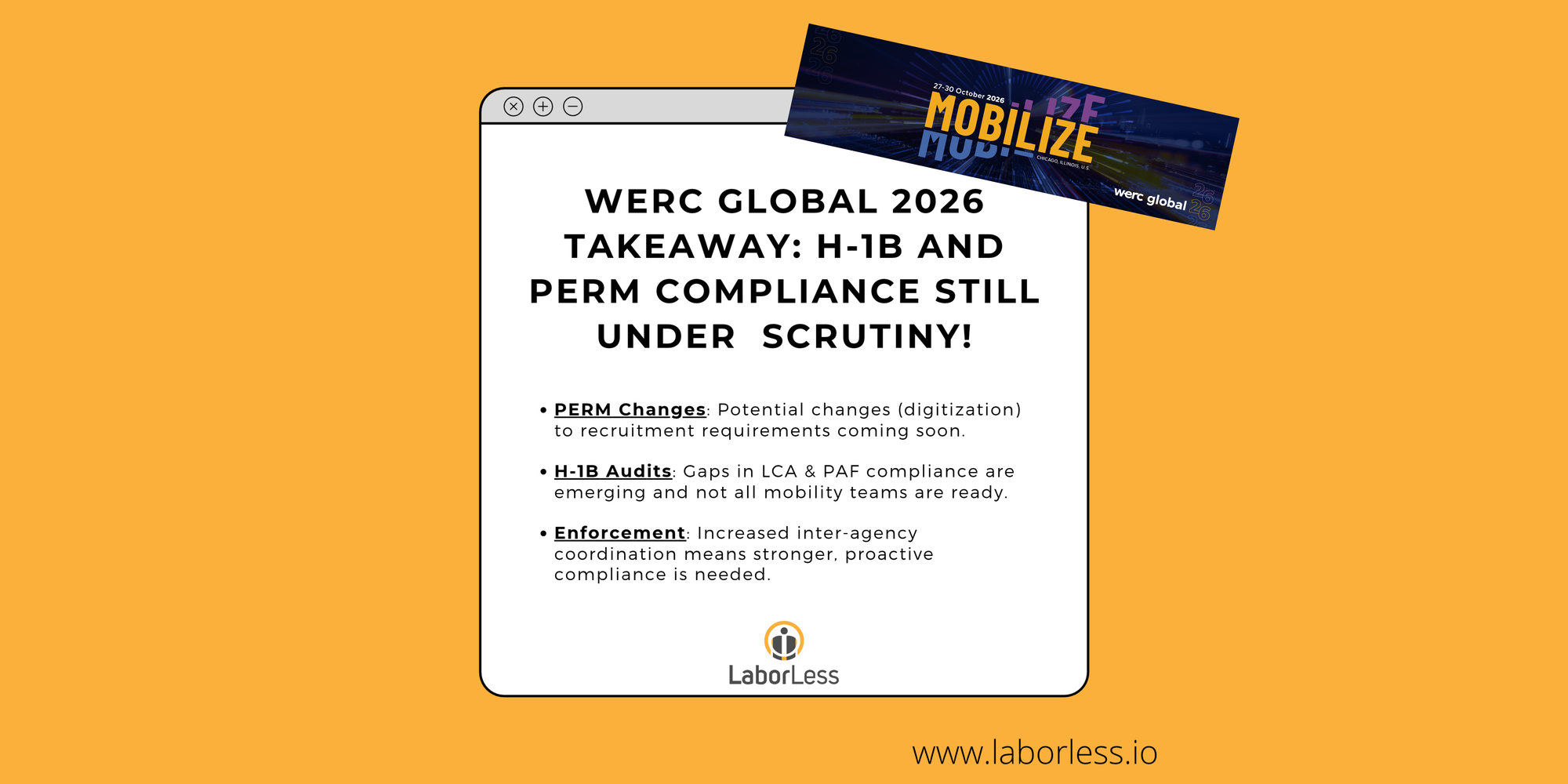
At this year's WERC Global 2026 conference in Chicago, one of the most important themes across several immigration compliance sessions was that employers are beginning to discover that their compliance programs may not be as comprehensive or reliable as they previously believed.
For years, many companies operated under the assumption that their H-1B and PERM compliance processes were working properly. Labor Condition Applications (LCAs) were filed, Public Access Files (PAFs) were maintained, PERM recruitment was conducted, and immigration attorneys provided instructions to HR teams. If there were no complaints or government investigations, there was little reason to question whether those processes were functioning as intended.
But the absence of government scrutiny does not necessarily mean a company has been compliant.
That distinction came up repeatedly during discussions about Department of Labor (DOL) enforcement, internal immigration audits, artificial intelligence, and coordination among federal agencies.
Three particularly sessions were relevant: Advanced: Auditing and Compliance, AI Meets Immigration Compliance: A Playbook for the Modern Mobility Team, and Immigration Compliance in the Crosshairs: Navigating DOJ IER, DOL, and EEOC Investigations.
Together, they highlighted an important shift in how employers should approach immigration compliance. Rather than treating documentation as something to collect and store, companies increasingly need to verify that their records are complete, accurate, consistent, and capable of withstanding scrutiny.
For employers sponsoring H-1B workers or pursuing PERM labor certification, that means taking a much closer look at the processes they may have relied upon for years.
DOL Immigration Audits Are Exposing Gaps in Previously Accepted Compliance Processes
One of the strongest takeaways from the conference was that having an immigration compliance program is not the same as knowing whether that program works.
This was especially apparent during the Advanced: Auditing and Compliance session, which addressed how companies can conduct internal reviews, prioritize findings, and improve their immigration compliance processes.
The panel, moderated by Carol Williams of Williams Immigration, included Ashlee Drake Berry of Casium, Michele Frangella of Charles River Associates, and Dominique Lelonek of Acuity.
A recurring question was whether employers are maintaining the right documentation and whether that documentation would actually stand up to an investigation.
Consider a company that sponsors hundreds of H-1B employees each year. Its immigration counsel prepares LCAs and sends posting instructions to the appropriate HR contacts. Someone at the company is responsible for completing the postings and maintaining the PAFs.
On paper, the process looks reasonable.
But an internal audit may reveal that some notices were posted at the wrong locations, posting confirmations were never returned, or supporting PAF documents were stored in separate systems.
The employer may have assumed those steps were completed because nobody had previously challenged the process.
This is one reason proactive immigration compliance audits are becoming increasingly important. Employers should not simply confirm that a PAF or PERM audit file exists. They should verify whether the documents inside it are complete, accurate, and consistent with applicable legal requirements.
What Should Employers Review During an H-1B Compliance Audit?
Under 20 CFR § 655.760, H-1B employers must make certain LCA-related documentation available for public examination.
A compliant PAF generally includes the certified LCA, wage-related documentation, an explanation of the employer's actual wage system, prevailing wage information, benefits documentation, and evidence of the required LCA notice. Additional requirements may apply depending on the employer's circumstances.
An internal review should therefore look beyond whether a folder labeled "PAF" exists.
Employers should consider whether:
- Every applicable LCA has a corresponding, complete PAF.
- Wage and benefits documentation is accurate and current.
- Required LCA notices were properly provided and documented.
- Posting records identify when and where notices were made available.
- Records are accessible for public inspection and government review.
- Retention schedules and any applicable preservation obligations are being followed.
The purpose is to identify discrepancies before an investigator does.
This is also why employers should consider comparing their internal LCA records against the government's public LCA data. A company may discover certified LCAs that do not appear in its internal inventory, or PAFs that are missing supporting documents.
The underlying issue is straightforward: instructions and reminders are not substitutes for documented compliance.
PERM Recruitment Requirements May Change as DOL Reexamines Traditional Hiring Practices
Another major topic at WERC Global was the possibility of significant changes to the PERM labor certification process.
During the Immigration Compliance in the Crosshairs session, panelists discussed the prospect of modernizing PERM recruitment requirements to better reflect how employers actually recruit workers today.
Traditional PERM recruitment procedures can involve newspaper advertisements and other methods that do not always resemble an employer's ordinary hiring practices.
Meanwhile, many companies primarily recruit through their websites, LinkedIn, electronic job boards, and digital applicant-tracking systems.
Panelists discussed the possibility that future PERM regulations could place greater emphasis on these modern recruitment channels and on whether recruitment is conducted fairly and consistently.
These were discussions about potential regulatory changes, not confirmation that new requirements have taken effect. Any future proposal, final rule, or other agency action would need to be evaluated on its own terms.
Nevertheless, employers should pay attention to the underlying compliance concern.
PERM Recruitment Should Be Consistent With Legitimate Hiring Practices
One point raised during the conference was that PERM recruitment should not be treated as an entirely separate hiring exercise disconnected from how the employer normally evaluates U.S. applicants.
Under 20 CFR § 656.10, employers make several important attestations, including that the job opportunity is clearly open to U.S. workers and that U.S. applicants are rejected only for lawful, job-related reasons.
That means compliance involves more than publishing advertisements and retaining screenshots.
Employers should examine whether their recruitment procedures give qualified applicants a meaningful opportunity to apply, whether the hiring criteria are consistent with the position, and whether applicant evaluations are documented appropriately.
This is especially important when PERM recruitment occurs after layoffs or workforce restructuring.
An employer may satisfy the technical advertising requirements but still face questions about the broader recruitment process, including how applicants were evaluated and whether the position was genuinely available.
The conference discussion reinforced the importance of reviewing those processes before new requirements or enforcement questions arise.
PERM Notice of Filing Compliance Is Another Area Worth Reviewing
Separate from recruitment advertising, employers must also comply with applicable PERM Notice of Filing (NOF) requirements.
Under 20 CFR § 656.10(d), where workplace posting is required, the notice generally must remain posted for at least 10 consecutive business days within the prescribed period before filing.
Employers must also use applicable in-house media, whether electronic or printed, in accordance with their normal procedures for recruiting similar positions.
For companies that routinely advertise internal opportunities through employee portals, intranets, or internal job boards, this can create an additional documentation obligation.
Importantly, electronic in-house media posting does not automatically replace the required physical workplace posting.
As employers prepare for potential PERM modernization, reviewing existing recruitment and NOF procedures is a practical place to start.
AI Is Becoming a Useful Immigration Compliance Tool, but It Cannot Replace Human Review
Artificial intelligence was another major topic at the conference, particularly in discussions about how immigration and global mobility teams can manage large volumes of data while preparing for audits and investigations.
During AI Meets Immigration Compliance: A Playbook for the Modern Mobility Team, speakers discussed how AI can support immigration operations, identify potential compliance issues, and improve visibility into employer records.
One particularly useful application involves H-1B Public Access Files.
Instead of manually opening hundreds of PAFs to determine whether each contains the required documentation, a company may use AI-assisted tools to inventory documents, identify potentially missing records, and flag inconsistencies for further review.
Another application involves comparing an employer's internal LCA inventory with publicly available DOL data.
This can help identify possible discrepancies between the LCAs the government has certified and the records the employer maintains.
AI-Assisted PAF Audits Can Reveal Missing Documents and Inconsistent Records
The potential benefits of AI-assisted compliance reviews include identifying missing documents, classifying records, comparing information across systems, and spotting patterns that may warrant investigation.
For example, if a company experiences several government site visits involving employees in similar roles or at the same location, reviewing those patterns could help the immigration team identify other employees who may need additional preparation.
Likewise, automated checks could flag inconsistent job titles, worksite information, or wage-related records for legal review.
But the speakers also highlighted an important limitation: AI can make mistakes.
An AI system might incorrectly report that a required document is missing because it cannot recognize a scanned signature. It might provide an inaccurate count of H-1B employees because it searched an incomplete dataset or misunderstood the request.
These errors illustrate why AI-generated findings must be verified.
The better approach is to use technology to identify possible issues while relying on qualified professionals to interpret the results, investigate discrepancies, and make legal determinations.
AI Compliance Tools Also Require Data Governance
Immigration records often contain sensitive personal and employment information.
Before introducing AI into compliance workflows, employers should understand where the data comes from, who can access it, how it is processed, and whether the system is appropriate for the information involved.
A useful AI compliance tool must operate on reliable data. If an employer's underlying LCA inventory is incomplete, the system may produce misleading results regardless of how sophisticated its analysis appears.
This leads to a broader lesson: AI works best when employers already have organized records and consistent processes.
Automation can strengthen a compliance program, but it cannot compensate for missing documentation or unclear internal responsibilities.
Coordinated Government Investigations Require a Company-Wide Compliance Strategy
The Immigration Compliance in the Crosshairs session addressed another important development: the increasing intersection of immigration enforcement with broader workforce and employment compliance.
The session featured Kelli Duehning of BAL, Alexander Maugeri of Jones Day, and April Williams of WilmerHale.
One of the central discussion points was that employers may receive inquiries from different government agencies concerning overlapping employment practices.
These can include the Department of Labor, the Department of Justice's Immigrant and Employee Rights Section (IER), and the Equal Employment Opportunity Commission (EEOC).
Although these agencies have distinct responsibilities and legal authorities, their investigations can involve related records, hiring decisions, and employment practices.
Inconsistent Responses Can Create Additional Problems
Consider a company that receives a government inquiry about recruitment practices.
Its HR department gathers documents and provides a response. Several months later, a different agency asks questions about overlapping employment decisions.
If the immigration team, HR department, legal department, and business leaders are not coordinating, their responses may describe the same events differently.
Even when those differences are unintentional, inconsistent statements can create credibility problems or require further explanation.
The panel emphasized the importance of understanding the broader scope of an investigation, coordinating among relevant stakeholders, preserving documents, and conducting an appropriate internal review before responding.
That does not mean delaying responses beyond applicable deadlines. It means ensuring that the company understands the facts and has a coordinated response strategy.
Some organizations may benefit from establishing an internal risk committee or similar cross-functional group that can quickly evaluate new immigration policies, investigations, and compliance concerns.
Such a group might include immigration counsel, HR, global mobility, employment counsel, and other relevant business stakeholders.
The goal is to avoid treating each government request as an isolated administrative issue when it may have implications across the organization.
Proactive H-1B and PERM Compliance Requires Better Systems, Not Just More Checklists
Across all three sessions, the most consistent takeaway was that employers need to become more proactive.
Many immigration compliance obligations are relatively straightforward when considered individually.
An employer must provide LCA notice, maintain a PAF, retain supporting documentation, and comply with applicable PERM recruitment and Notice of Filing requirements.
But these obligations become more complicated when a company sponsors hundreds or thousands of foreign national employees across multiple offices, remote locations, and third-party worksites.
A process that works for ten filings may become unreliable when scaled to a thousand.
Electronic LCA Posting Must Be Accessible and Documented
Under 20 CFR § 655.734, employers must provide required LCA notice to affected workers through an authorized method.
For electronic posting, simply placing a notice somewhere online is not necessarily sufficient.
DOL Field Assistance Bulletin 2019-3 explains that affected workers must be able to access the electronic notice and know where to find it.
This is particularly relevant when H-1B employees work remotely or at third-party client locations, where the population entitled to notice may extend beyond the petitioning employer's own workforce.
Employers therefore need to consider not only whether a posting occurred, but whether it was accessible to the appropriate workers and whether the company can demonstrate compliance afterward.
Public Access Files Must Be Complete and Available for Inspection
PAFs present a similar challenge.
The employer may have a certified LCA, but the PAF can still be incomplete if the wage documentation, benefits statement, actual wage memorandum, or posting evidence is missing.
Records also need to be available for public inspection as required by regulation.
For large employers, maintaining these files through shared drives, spreadsheets, and email chains can create unnecessary administrative work and make it difficult to verify completeness.
The same is true for record retention.
Employers should understand how long records must be retained, when applicable retention periods end, and whether documents must be preserved because of an ongoing investigation or other legal obligation.
A reliable compliance process should make those records easy to locate, review, and produce without requiring employees to reconstruct events from years earlier.
How LaborLess Helps Employers Strengthen H-1B and PERM Compliance
The discussions at WERC Global reinforced exactly why we built LaborLess.
Employers and immigration law firms need more than instructions explaining what must be done. They need practical systems that help ensure routine compliance tasks are completed, documented, and accessible when questions arise.
LaborLess helps address several of these administrative challenges through:
- Electronic LCA posting: Centralized posting workflows, automated posting removal, and documentation of posting activity, including support for remote and third-party worksite scenarios.
- Automated PAF generation and management: Creation and organization of Public Access Files, helping employers and law firms maintain required supporting records in a centralized environment.
- Detailed audit logs: Records of relevant posting and document activity, including timestamps and user actions, to support internal reviews and government inquiries.
- PAF retention management: Tracking retention periods and supporting automated destruction according to configured schedules, subject to applicable preservation requirements.
- PERM Notice of Filing posting: Electronic NOF posting workflows and supporting evidence to help employers document applicable in-house media posting requirements.
For immigration law firms, these capabilities also provide greater visibility into the administrative compliance processes their corporate clients are responsible for completing.
Instead of sending posting instructions and hoping that everything was handled correctly, law firms and employers can work through a more centralized, documented process.
Technology does not replace immigration counsel, determine whether PERM recruitment was lawful, or guarantee that a company will pass an audit.
It can, however, reduce preventable administrative errors and make it easier to verify that required steps were completed.
That distinction matters in the current enforcement environment.
The Main Takeaway from WERC Global 2026: Review Immigration Compliance Before the Government Does
The biggest takeaway from WERC Global was not that every employer has a major compliance problem - it was that many employers may not actually know whether their immigration compliance processes are working as intended.
Employers should be asking whether their PAFs are complete, whether LCA postings were properly documented, whether PERM recruitment and NOF procedures are consistent, and whether their records could withstand an internal or government review.
The companies that address these questions proactively will be better positioned to respond to whatever comes next.
At LaborLess, our goal is to make the administrative side of H-1B and PERM compliance easier to manage, document, and verify.
If your organization or immigration law firm is reviewing its LCA posting, PAF management, or PERM Notice of Filing processes, visit www.laborless.io or reach out to our team to learn how we can help.
Frequently Asked Questions About DOL Immigration Compliance
What are the biggest H-1B compliance risks for employers in 2026?
Common risks include incomplete Public Access Files, improperly documented LCA postings, inaccessible electronic notices, inconsistent wage documentation, and failures to maintain records for the required period. Employers with remote workers or employees at third-party worksites may face additional posting challenges. These risks are governed by existing H-1B regulations, regardless of whether new enforcement initiatives are announced.
What should employers review during an internal H-1B compliance audit?
Employers should verify that their LCAs and PAFs are complete, that wage and benefits documentation is accurate, and that required notices were properly provided. They should also examine posting evidence, record retention, and consistency between internal records and DOL data. The applicable PAF requirements are outlined in 20 CFR § 655.760.
Are PERM recruitment requirements changing in 2026?
PERM modernization was a significant topic at WERC Global 2026. Panelists discussed potential changes that could place greater emphasis on modern electronic recruitment channels and fair recruitment practices. However, conference discussions do not establish new legal requirements. Employers should continue following the regulations currently in effect while monitoring official DOL rulemaking.
Can AI be used to audit H-1B Public Access Files?
Yes. AI-assisted tools can help inventory PAF documents, flag missing information, compare records, and identify potential inconsistencies. However, AI findings require human verification because automated systems can misinterpret documents or generate inaccurate results. Employers should also establish appropriate safeguards for sensitive employee information.
How long must an H-1B LCA notice be posted?
When an employer uses the posting method, the required LCA notice period is at least 10 days, subject to the applicable regulatory requirements. Electronic notice must be practically accessible to affected workers, including relevant workers at third-party locations. See 20 CFR § 655.734 and DOL Field Assistance Bulletin 2019-3.
How long must a PERM Notice of Filing be posted?
Where the workplace posting requirement applies, a PERM Notice of Filing generally must be posted for at least 10 consecutive business days within the required 30-to-180-day period before filing. Applicable in-house media requirements must also be satisfied. Electronic in-house media posting does not automatically replace required physical posting. See 20 CFR § 656.10(d).
How does LaborLess help employers prepare for DOL audits?
LaborLess helps employers and immigration law firms automate electronic LCA postings, generate and maintain PAFs, preserve detailed activity logs, manage retention schedules, and document electronic PERM Notice of Filing postings. These capabilities make it easier to organize and retrieve compliance records, although legal review and broader audit preparation remain essential.